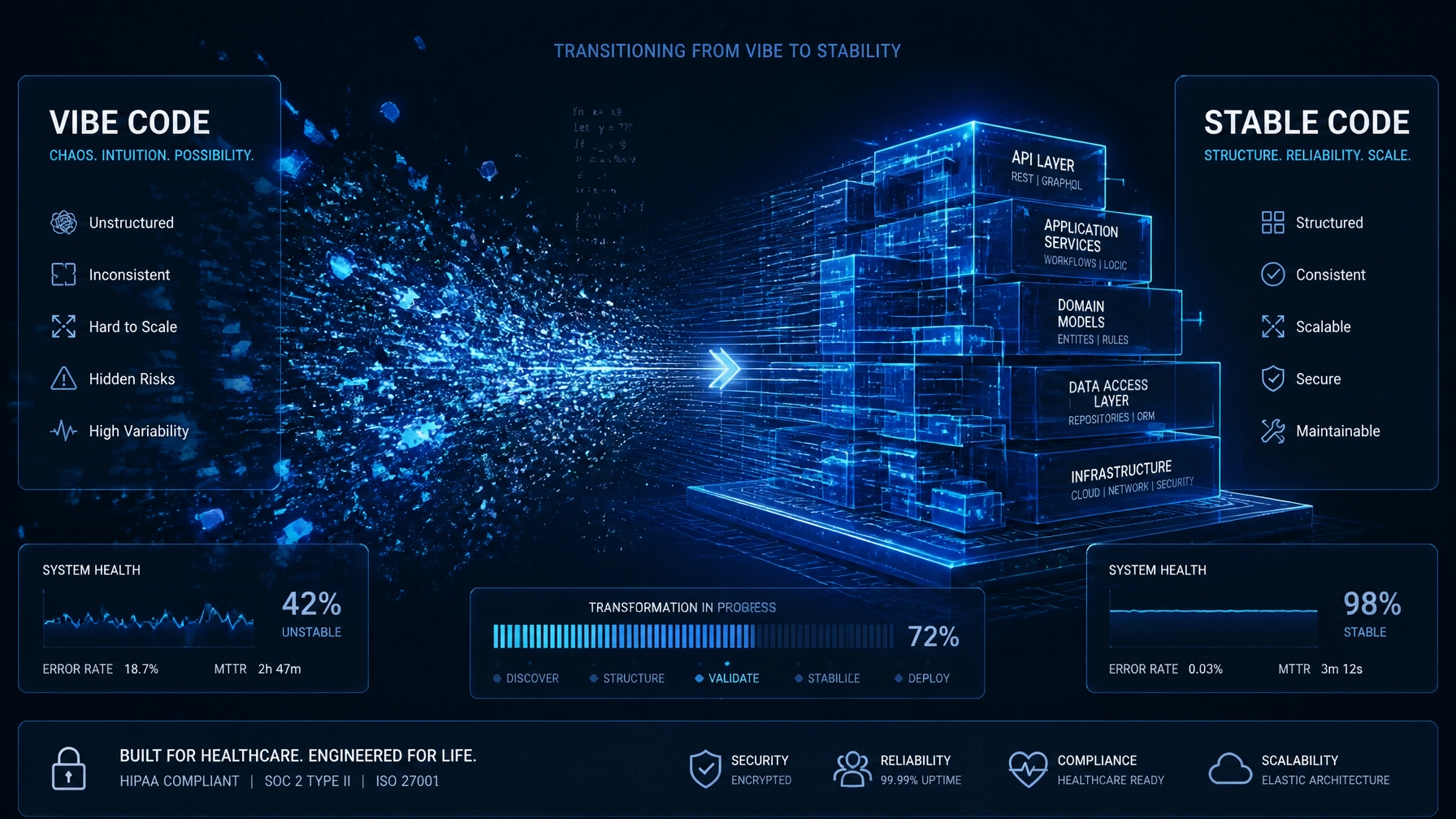

I’ve always had an easier time trusting things I can test.
Press a button and the same thing happens ten times, my brain relaxes.
Change one variable, the output changes, and I understand the relationship.
That’s the comfort of traditional software.
It may be complicated. It may have thousands of moving parts. But at the end of the day, it still behaves like a machine. Input goes in. Rules are applied. Output comes out. Something breaks, you trace it, you fix it, you test again.
That kind of cause and effect feels safe.
A lot of life does not work that way.
Parenting is the cleanest example I have.
You tell your kid the same thing a hundred times. Be patient. Tell the truth. Take a breath before reacting. Some days it feels like nothing is landing.
Then months later, they pause before a hard moment and make a better choice. And you cannot really tell what caused it.
Was it the lesson? The repetition? The example? The age? One conversation they barely reacted to at the time?
You don’t really know.
The cause and effect is there. It just is not clean. Not immediate. Not easy to isolate.
That’s the world LLMs live in too. And in healthcare, we do not have the luxury of shrugging at it.
The shift most teams missed
For years, healthcare software had a simple mental model. We wrote rules, tested the rules, verified the output. If the patient had this status, the workflow moved there. If the value was above a threshold, the system showed an alert. It was not always easy, but it was deterministic. Same input, same logic, same output. Quality could be tested cleanly.
LLMs broke that contract.
The system does not only execute rules anymore. It interprets, retrieves, ranks, summarizes, reasons, fills gaps, decides what context matters, decides what to ignore. It may give a helpful answer nine times and a different answer the tenth because the prompt changed, the retrieved source changed, or the model interpreted the question differently. That is not automatically bad. It is part of what makes LLMs useful.
But it changes the job. A clinical AI system is not a feature you build. It’s a behavior you have to characterize. And behavior tests differently than logic.
Where the trouble starts
Most teams I see test the demo. They test the happy path. They ask the system a few clinical questions, the answers look good, the pilot feels promising, the screenshots are clean. Founder gets excited. Buyer leans in.
Then real usage starts.
A clinician phrases the question a different way. A patient uploads messy records. Two source documents contradict each other. The system retrieves the wrong section. A lab value gets interpreted without enough context. A summary sounds confident, but the evidence behind it is thin. A recommendation is technically plausible but wrong for the actual workflow.
Nobody planned for that exact situation, and that is the point. Clinical AI does not only fail because it hallucinates. It fails because small changes in context create large changes in output, and the failures rarely look like failures.
A normal software bug is easier to explain. The rule failed. The calculation was wrong. The API returned an error. With clinical AI, the failure usually comes from a chain of small things. The user asked vaguely. Retrieval pulled the wrong document. The model over-weighted one source. The prompt did not force uncertainty. The system did not detect contradiction. The output looked polished enough to feel trustworthy.
That last part is the dangerous one. Bad clinical AI does not always look broken. Sometimes it sounds reasonable. Sometimes it gives an answer that is half right, which is often worse than obviously wrong.
What actually needs to be tested
The better questions are not the ones most teams ask. “Does it answer” and “does it use RAG” and “do we have a BAA” are necessary, but they are not sufficient. The harder questions are the ones that show up in enterprise review:
Where does it break? What kinds of questions make it break? What happens when sources disagree? Can every answer be traced back to evidence? Does the system know when it should not answer at all? Can we reproduce the failure when it happens? Can we explain why the answer changed between two similar prompts? Can we prove where patient data went?
That is the shift. Healthcare AI teams should not only test outputs. They have to test behavior, because the real risk is not that the system gives a bad answer once. The bigger risk is not knowing when, why, or how it gives a bad answer. That gap is what breaks clinician trust, slows enterprise procurement, and makes legal and security teams nervous in ways founders rarely see coming.
Healthcare already runs on uncertainty. Patients are messy. Records are incomplete. Terminology varies. Different clinicians document differently. Labs come from a long tail of formats. Guidelines evolve and evidence shifts. Drop an LLM into that environment and the system has to be built with humility. It has to assume ambiguity, handle contradiction, show its work, fail safely, and be clear about what it knows, what it does not, and what evidence shaped the answer. That is not a technical preference. It is a trust requirement.
The one thing founders need to internalize
You do not have to become an expert in every model, vector database, prompt strategy, or retrieval pattern.
But you do have to internalize this:
A working demo is not the same thing as a reliable clinical AI system.
A demo proves the system can work.
A reliability process shows where it breaks.
Those are not the same thing. And teams that confuse them get punished later, usually during the procurement cycle they were counting on to close.
The teams that understand this early have an advantage. Not because they move slower, but because they avoid rebuilding the system after security review. They avoid surprises in enterprise evaluation. They know what to fix first. They have evidence when buyers ask hard questions.
They can say, “We know where the risks are, and here is how we manage them.” That is the sentence that actually moves clinical AI deals forward.
In healthcare, trust is not created by saying the AI is accurate.
Trust is created by showing how the system behaves when things get difficult.
The edge cases. The vague questions. The missing data. The contradictory sources. The PHI exposure paths. The stale evidence. The retrieval failures. The confident but unsupported answer.
That is where clinical AI earns trust.
Not in the perfect demo.
In the messy real-world scenario.
Which brings us back to cause and effect. We like systems where the relationship between input and output is obvious. Clinical AI is not that. A small change in input can change the conclusion. A small change in retrieved context can change the recommendation. A small missing guardrail can produce a risky answer that nobody catches until it is in front of a clinician. A small gap in traceability becomes a big problem the first time a security team starts asking real questions.
The answer is not to avoid clinical AI.
The answer is to stress it before users do. Question it before clinicians do. Map the data flows before security teams do. Trace the evidence before buyers ask for it. Find the weak points before they become public.
That is what clinical AI reliability actually is.
Not fear. Not compliance theater. Not a brake on innovation.
It is the work of building systems that deserve the trust they are asking for.
Because in healthcare, “mostly works” is not a strategy.
If you’re building a clinical AI product and you’re not yet sure where it breaks, this is the work we help healthtech teams think through. Send me a message.