You built a demo. It works. The board is happy. You asked the AI to build a feature and it spat out code that actually runs. It feels like magic, right?
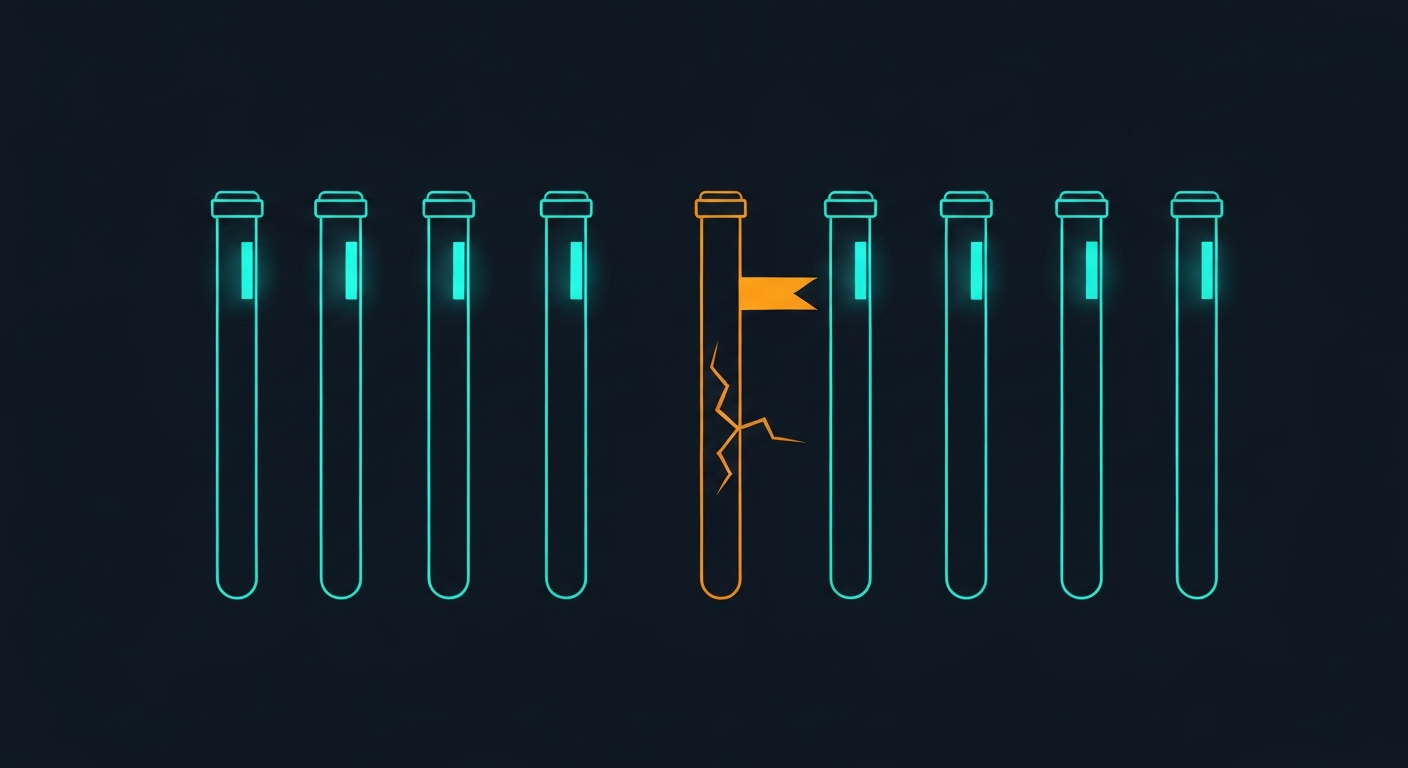
But late at night, when you are staring at your ceiling, you feel that knot in your stomach. You know that if three people hit that endpoint at once, or if a weird data edge case pops up, the whole thing might just fold. That is the cost of vibe code.
The Vibe Code Trap
Most healthcare AI companies start with vibe code. It is the natural first step. You use AI assistants to glue things together. You copy and paste snippets. You optimize for the demo. You want to see the “wow” factor on a stakeholder’s face.
In a sandbox, this is fine. In a vacuum, it is brilliant. But healthcare does not live in a vacuum. It lives in a world of strict regulations and life critical data. Vibe code is fragile code. It is code that works because of a specific set of circumstances, not because it was engineered to last.
When you are building healthcare software development projects, you cannot rely on vibes. You need a core that can stand up to a deep audit. You need something that won’t quietly go wrong before it loudly goes wrong.

The Midnight Panic
There is a specific kind of anxiety that comes with technical debt. It is not just about a bug. It is the fear that you are building a skyscraper on a foundation of wet sand.
Think about your current prototype. If a regulator walked in tomorrow and asked for the exact provenance of every piece of data that influenced a specific AI output, could you give it to them? If a patient’s record was leaked because of a simple injection flaw in your glue code, what happens to your company?
That anxiety is your brain telling you that your prototype is not a product yet. It is a sketch. Real confidence comes from knowing that your HIPAA compliant software development isn’t just a checkbox on a slide deck. It is a living, breathing part of your architecture.
Why Healthcare is Different
In other industries, “moving fast and breaking things” is a badge of honor. In healthcare, breaking things means losing trust. It means legal exposure. It means potentially hurting people.
When you deal with PHI (Protected Health Information), the rules change. Vibe code usually lacks the structural pillars of production engineering. It lacks granular RBAC (Role Based Access Control). It lacks comprehensive logging. It lacks the ability to trace an answer back to its specific source document and model version.
If your RAG (Retrieval-Augmented Generation) pipeline is just a few scripts hitting a vector database, you are in the vibe zone. You are missing the data governance that separates a toy from a medical grade tool. You can learn more about how we handle AI and LLM testing to prevent these exact failures.
Moving to Stable Code
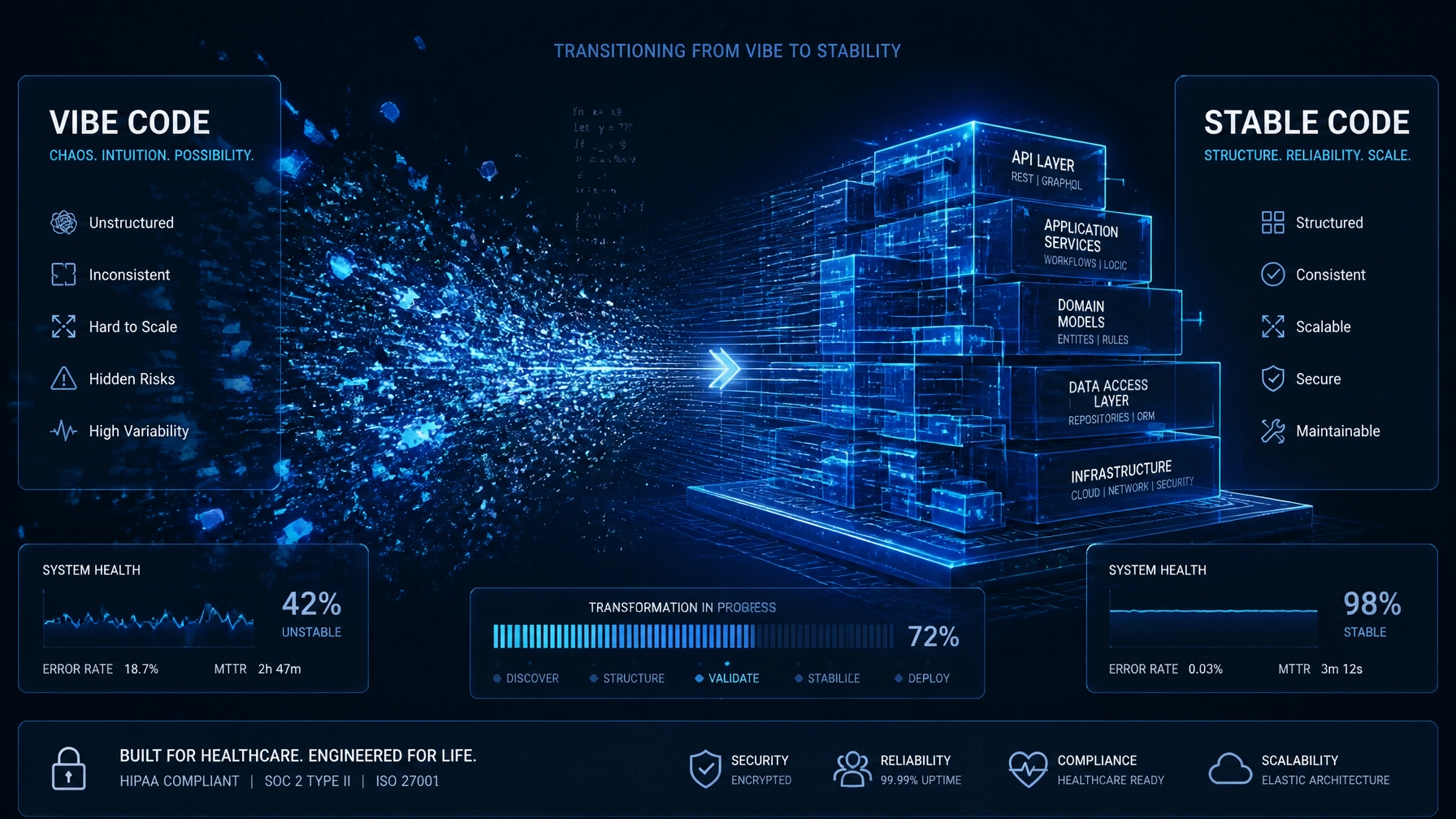
So how do you bridge the gap? You don’t just “fix” vibe code. You refactor it into stable code. You move from “intent-driven generation” to “engineered reliability.”
Stable code means your architecture is intentional.
- You have identity and access management baked in from day one.
- You have automated redaction and anonymization for PHI.
- You have metric-driven evaluation for your AI outputs.
This is where many founders get stuck. They have a team that is great at the “zero to one” prototype phase, but they lack the senior engineering bandwidth to harden that code for production. This is why we provide dedicated developer pods. We don’t just give you a list of problems. We embed with you and build the solution.
We have seen this play out dozens of times. A startup builds a flashy AI tool, gets a pilot with a major hospital, and then realizes their infrastructure can’t handle the security review. They scramble. They panic. They hire us to fix the mess. It is always better (and cheaper) to build it right the first time. You should check out our guide on how to research your web app idea to ensure your foundation is solid before you write a single line of code.
The Pillars of Production AI
If you want to move to stable code, you need to focus on three things:
- Provenance: You must be able to prove why the AI said what it said. This means versioning your prompts, your models, and your data chunks. No more “black boxes.”
- Hardened Pipelines: Your data flow needs error handling, retries, and circuit breakers. If an API goes down, your whole system shouldn’t crash.
- Auditability: You need logs that satisfy HIPAA requirements. Who accessed what? When? Why?
When these pillars are in place, the anxiety starts to fade. You aren’t just crossing your fingers and hoping the demo works. You are operating a system that you understand and control.

The Confidence of a Stable Foundation
Imagine walking into your next board meeting with total peace of mind. When they ask about scalability, you don’t give them a vague sales dance. You show them a technical roadmap that is already being executed.
You show them that your healthcare software development is built on production grade infrastructure. You show them that you have moved past the “vibe” phase and into the “stable” phase.
This is the difference between a project and a company. A project is a prototype that works sometimes. A company is an engineered system that works every time.
Why Founders Trust Us
At Vantage IO, we don’t do “consulting decks.” We do engineering. We are a founder-led team of senior experts who have actually built this stuff in production. We don’t just tell you that your code is fragile. We show you exactly where it will break and we fix it before it happens.
We provide senior engineering leadership that embeds directly with your team. We help you scale from that first messy prototype to a fully compliant, production ready platform. We take the weight off your shoulders so you can focus on the vision while we handle the architecture.

Final Thoughts
Vibe code got you here. It got you the funding. It got you the buzz. But it won’t get you to the finish line.
In the high stakes world of healthcare, the transition from vibe code to stable code is the most important move you will make. It is the move that turns a risky experiment into a valuable asset.
Stop worrying about when your code will break. Start building something that is built to last.
Ready to turn your prototype into a production-grade powerhouse? Let’s have a conversation. No high pressure sales pitch. Just a direct look at your architecture and a plan to make it stable.